
There is a number on the checkout page and there is a number you will actually pay, and in the domain industry those two have almost nothing to do with each other.
Register a .com for $0.99. Feel clever. Then, eleven months later, an email arrives saying your renewal is $21.99, and it renews at $21.99 every year after that, forever, because a domain is not a purchase — it is a subscription with a one-year minimum term and a very long tail.
This is not a scam. Every price is disclosed somewhere. It is just that the industry has settled on advertising the one number that is least useful for making a decision, and it works because nobody comparison-shops a purchase that costs less than a sandwich.
Here is what is actually going on underneath, and the specific moves that beat it.
Where the money goes
A domain price has four layers, and only one of them is competing for your business.
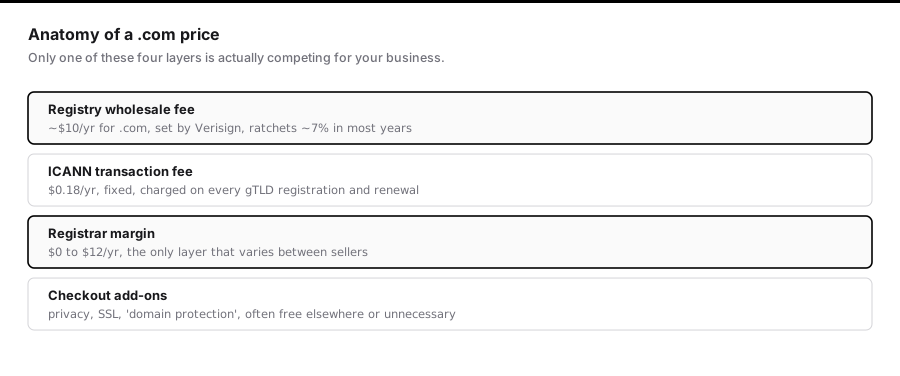
The registry operates the extension. Verisign runs .com and .net; Public Interest Registry runs .org; Identity Digital runs a large chunk of everything else. The registry charges every registrar the same fixed wholesale fee per domain per year. Your registrar cannot negotiate it.
ICANN takes $0.18 per domain per year on top, on every gTLD registration, renewal and transfer. Small, fixed, non-negotiable.
The registrar margin is the only part that varies. It ranges from literally zero to about $12 a year for the identical product, because there is no product differentiation available — a .com from an $8 registrar and a .com from a $22 registrar are the same record in the same registry database.
That structure has a useful consequence: there is a hard floor, and you can compute it. The .com wholesale fee is somewhere around $10 and ratchets upward most years. Add ICANN's $0.18 and you get the break-even price. Any .com advertised meaningfully below that is being sold at a loss, and a business selling at a loss has a plan for making it back. That plan is the renewal.
So the first useful reframe: a first-year price below wholesale is not a discount, it is a disclosure. It tells you the renewal is going to be expensive. Cheap year one and cheap year two are close to mutually exclusive.
Compare on five years, not on year one
The fix is arithmetic, not vigilance. Never compare registration prices. Compare the total cost of holding the domain for as long as you actually plan to hold it.
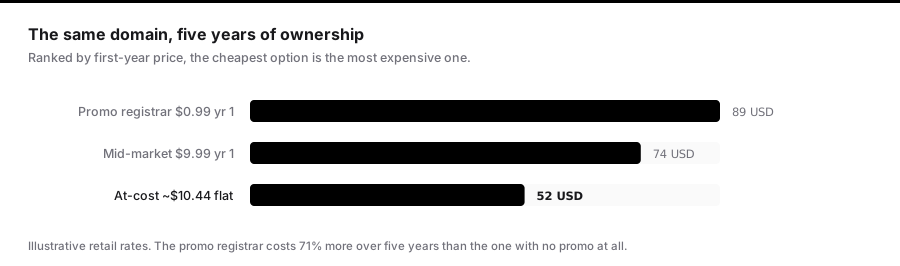
The registrar with the best headline price is often the worst place to own a domain, and the gap is not small — in the illustration above the "$0.99" option costs 71% more over five years than the registrar that never ran a promotion at all.
Five years is the right window for most projects. A domain you are genuinely testing an idea on might only need one. A domain you are putting on business cards, in an app store listing, or in a DNS record someone else depends on should be costed over ten, because that is realistically how long you will be stuck with it. Domains are far harder to change than they are to buy: every inbound link, every saved bookmark, every OAuth redirect URI and every email address is a hostage.
This is exactly the comparison I built TLDRadar to do — registration, renewal and transfer prices side by side across the registrars, so the multi-year number is visible before you buy rather than after. But you do not need a tool for it. You need to stop looking at the first number.
Not all extensions are allowed to raise prices
Here is the part that genuinely surprises people: whether your renewal can double next year is decided by a contract you have never read, and it differs enormously by extension.
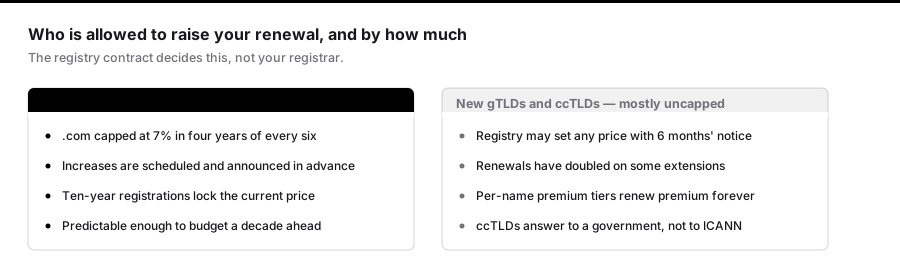
Legacy gTLDs like .com operate under registry agreements with explicit price caps. Verisign may raise the .com wholesale fee by up to 7% in four years out of every six, and increases are announced well in advance. It goes up, but it goes up on a schedule you can read, and it cannot suddenly triple.
Most new gTLDs — .app, .dev, .xyz, .shop, and the several hundred others — have no such cap. The registry agreement generally requires six months' notice of a price change and nothing else. Some extensions have used that freedom modestly. Others have not.
ccTLDs are a separate category again. .io, .ai, .co, .me, .tv, .sh, .ly are all country-code domains that happen to spell something in English, and they answer to a national government rather than to ICANN. That introduces a risk category that has nothing to do with price: the country can change the rules, change the operator, or in genuinely rare cases stop existing. If you are naming a company, this is worth ten minutes of reading. If you are naming a side project, it is worth knowing and then ignoring.
There is one more trap inside this: premium names. Registries can assign individual domains to a premium tier with a much higher price, and the tier usually applies to the renewal too, not just the registration. A domain that registers for $12 and renews for $300 is entirely normal and entirely legal. Always look at the stated renewal price for the specific name, not the extension's general price.
The moves that actually save money
Four of them are reliable. The rest is noise.
1. Transferring is renewing at someone else's promo price
This is the single most underused mechanism in the industry.
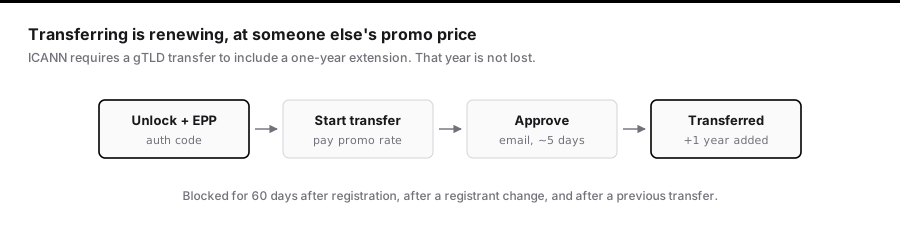
ICANN requires that transferring a gTLD to a new registrar adds a year to the registration. You do not lose the time you have already paid for; the new year stacks on top of your existing expiry date. And registrars discount transfers aggressively, because acquiring a customer from a competitor is worth more to them than a renewal.
So when your renewal comes up, do not renew. Transfer, at the transfer price, to a registrar you would rather be at anyway. You get the same year for less, and you end up somewhere cheaper for the following ones.
The constraints are worth knowing: a domain cannot be transferred within 60 days of registration, within 60 days of a previous transfer, or within 60 days of a change to the registrant contact. That last one catches people out — updating your own name or email address on a domain can silently start a 60-day clock.
2. Lock in years before the price rises
Registration length is capped at 10 years total. If an extension has an announced increase coming — and for .com they are always announced — renewing for multiple years beforehand locks the current rate for that whole period.
For a domain you are confident about, this is a small, boring hedge with a guaranteed return equal to the increases you skipped. It also removes the expiry risk described below for a decade, which is arguably the bigger win.
3. Use a registrar that does not have a margin
A few registrars sell at wholesale plus the ICANN fee and make their money elsewhere. Cloudflare Registrar is the well-known one; it charges you what it pays, with no markup and no promotional pricing in either direction. The trade-off is that you must use their DNS, and their TLD selection is narrower than a full-service registrar's.
Others — Porkbun, Namecheap, Dynadot are the usual names — run thin margins and include the things that should be free. Which is the cheapest for your extension varies more than you would expect, because registrar margin is set per-TLD.
4. Decline everything in the cart
Domain privacy should be free, and at most decent registrars it is. Paying $8/year to have your home address hidden from a public database is paying to fix a problem the registrar created.
You do not need their SSL certificate; Let's Encrypt is free, automated, and trusted by every browser. You do not need "domain protection" beyond the registrar lock that is already on by default and already free. You do not need their email hosting or their site builder, and you should be actively suspicious of bundling your registrar with your host — when you want to move hosts, you do not also want to be negotiating with your registrar about it. Keep the registrar separate from everything else. It is the one piece of infrastructure whose whole job is to still work when you change your mind about the others.
The expiry cliff
Everything above is about money. This part is about losing the domain entirely, which is more expensive than any renewal price.
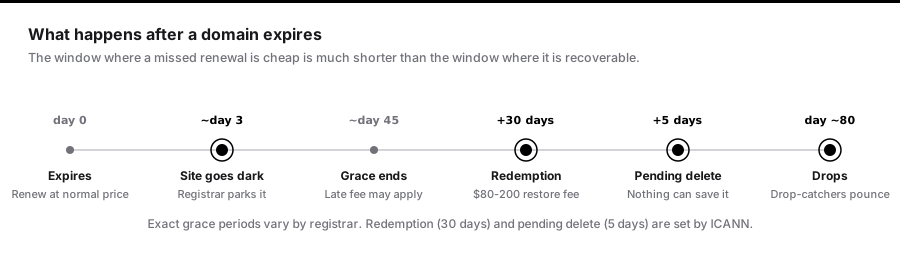
When a domain expires, it does not vanish — it enters a sequence of increasingly expensive states.
For roughly the first 45 days there is an auto-renew grace period where you can usually still renew at the normal price. But your site typically stops resolving within a few days, because the registrar repoints the nameservers at a parking page long before the domain is actually at risk. The outage arrives weeks before the danger does, which is why an expired domain usually announces itself as "the website is down" rather than as a billing problem.
After grace comes the redemption grace period: 30 days, mandated by ICANN, during which the domain is yours to recover but only through a restore transaction that typically costs $80 to $200. Then pending delete: five days during which nothing can be done by anyone. Then it drops, and if the name has any value at all, professional drop-catching services will register it within seconds of release.
Three defences, in order of how much they help:
- Register for multiple years. The expiry you cannot miss is the one that is nine years away.
- Keep auto-renew on, and keep the card on file valid. The most common cause of a lost domain is an expired credit card, not a forgotten renewal.
- Put the expiry date in your own calendar, 60 days ahead, not just the registrar's reminder system. Registrar renewal notices go to the registrant email address on the domain — which, if that address is at the domain, stops working at exactly the moment it matters.
That last failure mode is worth saying plainly: do not use an email address at a domain as the contact address for that same domain. When it lapses, every warning about the lapse is delivered to an inbox that no longer exists.
The short version
If you remember nothing else:
- Compare five-year totals, never first-year prices. The cheapest year one is frequently the most expensive decade.
- A price below wholesale is a signal, not a bargain. Roughly $10.20 is the floor for a
.com; below that, someone is planning to recover it. - Check the renewal price for the specific name, in case it is in a premium tier.
- Prefer capped extensions for anything permanent.
.comis boring and its price behaviour is boring, and boring is the feature. - Transfer rather than renew. You keep the time you paid for and gain a year at promotional rates.
- Never let the contact email live on the domain it protects.
Domains are the cheapest serious infrastructure you will ever buy and the most annoying to replace. Spending twenty minutes on the arithmetic once, at the start, is worth more than any amount of vigilance later.